youngCEO
Let children become the authors of their own work。
Young CEO is Yongle Education's flagship program — and where the whole system actually comes alive: research, philosophy, methodology and mechanism design all land, in the end, in real projects one by one. The most flagship of them all is called Young CEO.
it's about children becoming their own author。
CEO here doesn't mean “little boss.” Unfold the acronym again —Chief Exploration Officer — the “Chief Exploration Officer / First Author” of their own life and work. Its core isn't “being the boss,” but being the first owner of their own thing: why, what, how, and for whom — they set the direction, make the calls, and carry the responsibility, all themselves. In the AI era, skills can be outsourced, but authorship cannot. What Young CEO sets out to grow is exactly this: even when the machine can think for them, still wanting and able to decide for themselves — agency. This judgment comes from Creator Education。
An author
twists three abilities into one strand.
Authorship isn't a slogan. In terms of ability, it means honing “creativity × engineering × human-AI collaboration” at once in every real project, forged into a stable capability triangle。
CapabilityTriangle。
With “product / project” as the vehicle, motivation is sparked and the three core abilities are forged into a stable, mutually supporting triangle.
CreativityCREATIVITY
Finding what you want to make — sustained observation and judgment of the world. A sensitivity to meaning, emotion, culture and value, and the ability to ask good, real questions.
EngineeringENGINEERING
Turning ideas into reality — turning uncertainty into systems, models, products. The ability to turn one-off inspiration into reusable, scalable output.
Human-AI collaborationHUMAN × AI
Growing alongside AI — knowing what to hand to AI and what a human must judge; building a long-term working relationship with AI, treating it as an “ability amplifier,” not a “ghostwriter.”
These three abilities aren't drilled out of worksheets — they're forced out by a learning model of “Problem → Project → Product” — and these three P's are exactly the core of the creative loop above.
Problem-driven
Everything starts from a real problem — not one the teacher assigns, but one the child discovers and finds worth doing.
Project-based
Learning is organized around one complete project — they charter it, marshal AI and resources, and own the outcome, themselves.
Productization
In the end they ship a product / work the real world can use — not handing in homework, but delivering value.
And to make creation truly land in the world, you also have to, like an operator, practice these four things —
Need insight
Facing real needs, not a question bank. Every child's first-week assignment is to run a real user interview.
Product thinking
Engineering inspiration into a shippable work. From minimum viable prototype to deliverable product — broken down to weeks, days, concrete actions.
Reading feedback
Reading users, data and emotion. Data is cold, but a user's eyes and tone are warm — children learn to read both signals at once.
Iteration mindset
Treating failure as information. A version not working doesn't mean the child failed — it means that hypothesis failed. What to change next time.
Young CEO
issix institutions made real.
An author doesn't grow out of thin air — it takes the right organization. These six institutions — Mechanism Design explains the “why” — in Young CEO, they become six tangible, visible things.
Five borrowed from graduate education — the organization humanity knows best at “incubating creators at scale”;one invented because the AI-native era forced us to. Applied to one Young CEO cohort, each answers a concrete question —
Admissions system
Each cohort takes only 12. Three filters — interview + portfolio task + parent conversation — select for creator traits: initiative, curiosity, empathy, intrinsic drive, not grades.
Why 12One lead mentor can truly remember every child.One more and quality dips; one fewer and group momentum thins — 12 is the threshold.
Mentorship
Qiu Yiwu serves as lead mentor, joined by 9 kinds of senior creators. A mentor's first role isn't to teach knowledge, but to calibrate values, question direction, and ask high-quality questions.
Who walks children through uncertaintyAI can give answers; whether the direction is right takes a human to calibrate.
Mixed-age cohort
ages 9–15 together. Older children lead younger ones — fuller roles, natural collaboration, learning-by-teaching, a simulation of society.
Learning to collaborate in real relationshipsThe real world was never a world of one's own age.
Project-charter system
One real project each, six months from a felt problem to Demo Day. They raise the problem, define the goal, and carry the responsibility, themselves.
What children are actually learning forWhat's worth doing must be defined by oneself.(How the six months unfold, see below.)
Human-AI symbiosis
Not “knowing how to use AI,” but judging AI's limits, planning collaboration with AI, and growing in symbiosis with it. Treat AI as an ability amplifier, not a ghostwriter.
How to gain creativity beyond one's ageUsing AI is the operating layer; orchestrating intelligence is the creative layer.
Family-fund system
A co-building mechanism — family investment, shared commitment, a monthly co-creation meeting — that sustains the long view. Parents aren't spectators; they're co-builders.
How it stays sustainable long-termAuthorship can only be grown, never forced.
A cohort Young CEO,
unfolds like this.
AI has compressed “making” to a same-day prototype — so over these six months, the child's work isn't in “being able to build it,” but in finding the real problem, defining what good means, and closing in on it round after round. This is an AI-native creative loop.
Discover
AI can't tell you “what's worth doing.” Fieldwork, interviews, observation — turning a vague discontent into a real problem worth solving.
Frame
For whom, what success looks like, acceptance criteria — write them down first. Without a standard, no amount of AI output tells good from bad.
AI drives the cost of each round toward zero — so the contest is no longer “can you build it,” but judgment and taste. A version fails, you run another round, iterate dozens of times, closing in on “truly good.”
Co-create
The human sets the architecture and trade-offs, AI does the execution and generation — a usable prototype the same day. Using AI is the operating layer; orchestrating intelligence is the creative layer.
Validate
Get real users using it, with AI summarizing the data and feedback — but “right or wrong, good or bad” is for a human to judge.
Iterate
Bring real feedback back to co-creation, revise, try again. AI makes each round nearly free — the number of iterations is this generation's moat.
Ship · settle
A Demo Day showcase, a personal work page, a retrospective doc — a real delivery, entering Yongle's lifelong alumni network。
Seats per cohort
STUDENTS-month cycle
MONTHSAge range
AGEAlumni status
LIFETIMELed by real creators,
, guiding real young people.
Mentorship, made concrete: Young CEO is led by Qiu Yiwu as lead mentor, joined by 9 senior creators from different fields as project mentors — design, AI engineering, art, music, entrepreneurship, investment, academia, communication, media.
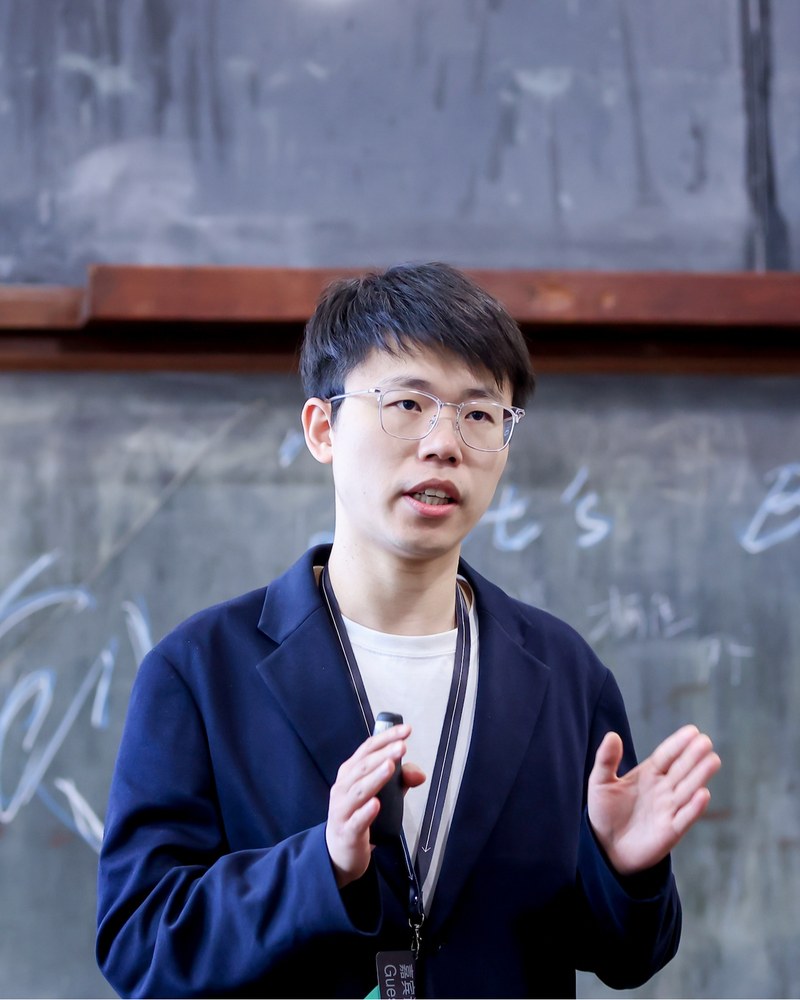
Qiu Yiwu
A graduate of ZJU's College of Computer Science, industrial design (2007).For over a decade he has taught in the MBA / design schools of ZJU, Xiamen and Sun Yat-sen universities, and advised companies like Li & Fung, Haier, Starbucks and China Mobile on applying AI.
The weekly teaching and one-on-one feedback for the 12 students of Young CEO's first cohort weekly teaching and one-on-one feedback are led by Qiu Yiwu.
Designer
DESIGNAI engineer
ENGINEERINGArtist
ARTSMusician
MUSICFounder
FOUNDERInvestor
INVESTORScholar
RESEARCHERWriter
WRITERMedia maker
MEDIAThe first cohort
is already running。
12 young people aged 9–15 are
now Zaowuyun, Hangzhoucompleting their first real project。
Selected by interview from schools like Wellington College Hangzhou, the 12 young people formally began on May 2026. Each is using AI to build their own IP, product, prototype — turning ideas into real things the world can use.
This path wasn't proposed out of nowhere — it grew from Spring 2025 at ZJU, Autumn 2025 at Tianyuan Academy — three AI-IP bootcamps — plus early 2026 co-creation sessions with parents at Wellington Hangzhou. Today, the first cohort is on its way.
Read “A Letter to Parents” →Cohort 02
now open。
6-month standard cycle · Hangzhou · on-site + online · 12 by admission · ages 9–15
Each week: one full day on-site + 1–2 online sessions of project coaching. Six months per cohort, from a felt problem to Demo Day.
On-site sessions are held in Zaowuyun, Hangzhou. Families from other cities are welcome to join online (a few key moments require being there in person).
Parents aren't spectators — one co-creation session a month, reviewing, adjusting and seeing alongside child and mentor.
A real work, a public showcase, a Yongle alumni card, entering the lifelong alumni network。
Skills can be outsourced;
authorship cannot.
Research, philosophy, methodology, mechanism design — pushed all the way here, all for one thing: to let a child grow into the authors of their own worktheir own author. Young CEO is where that chain of reasoning actually lands.